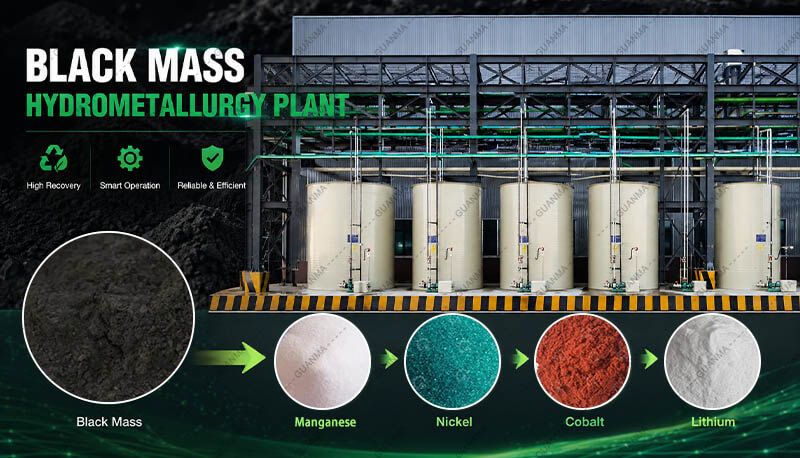
Transforming end-of-life batteries into high-purity critical metals demands a reliable Black Mass Hydrometallurgy Plant. As electric vehicle adoption soars, battery recyclers face a mounting stream of shredded battery scrap — known as black mass — rich in nickel, cobalt, manganese, and lithium.
The Challenge of Black Mass Processing
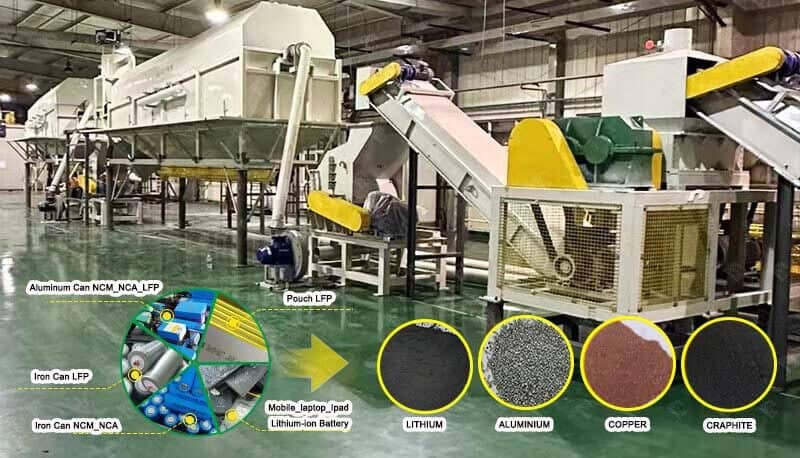
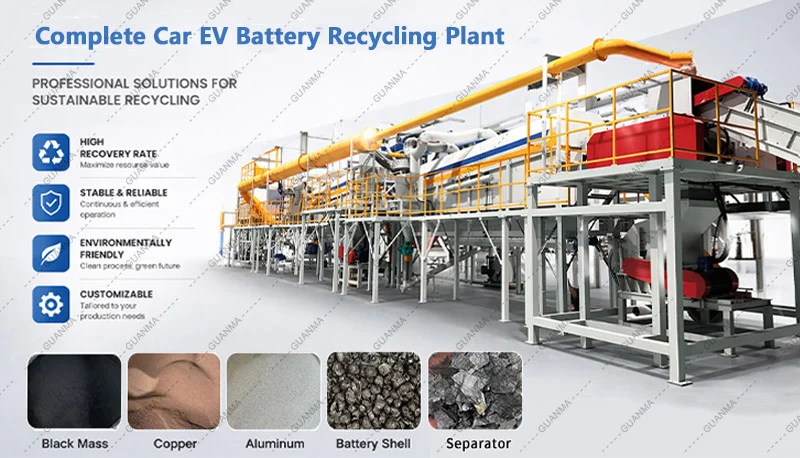
After mechanical pre-treatment, end-of-life lithium-ion batteries yield a fine powder containing cathode active materials, graphite, aluminum, copper, and electrolyte residues. This black mass is chemically complex and varies based on cell chemistry (NMC, LCO, LFP). Hydrometallurgical black mass plant selectively dissolves the valuable metals and refines them into separated, saleable compounds.
Process Flow of an Advanced Black Mass Hydrometallurgy Plant
1. Selective Leaching
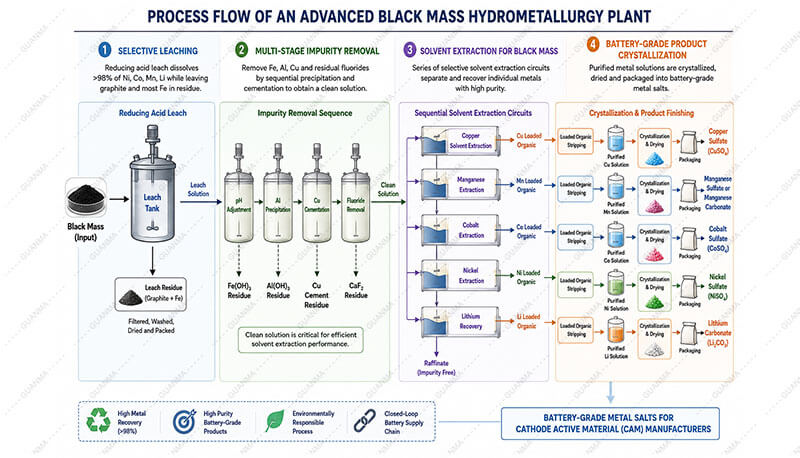
The black mass first undergoes a reducing acid leach. This black mass leaching step dissolves over 98% of nickel, cobalt, manganese, and lithium while leaving graphite and most iron in the residue.
2. Multi-Stage Impurity Removal
The pregnant leach solution contains impurities such as iron, aluminum, copper, and residual fluorides. Our plant applies sequential precipitation, cementation. Clean solution is critical for the solvent extraction stages that follow.
3. Solvent Extraction for Black Mass
This is the heart of the black mass hydrometallurgy plant. We deploy a series of selective solvent extraction for black mass circuits:
- Copper solvent extraction
- Manganese extraction
- Cobalt extraction
- Nickel extraction
- Lithium recovery
This sequenced separation yields individual high-purity streams ready for battery chemical production.

4. Battery-Grade Product Crystallization
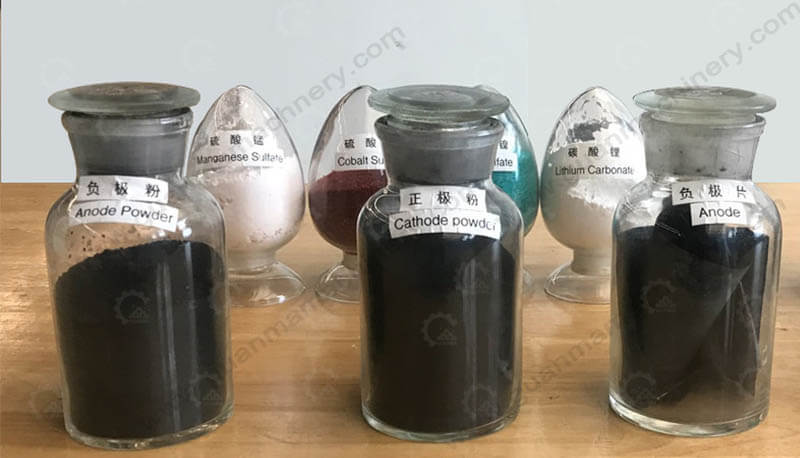
The purified metal solutions are then crystallized, dried, and packaged:
- Nickel sulfate
- Cobalt sulfate
- Manganese sulfate or manganese carbonate
- Lithium carbonate
These battery-grade metal salts can be directly sold to cathode active material (CAM) manufacturers, creating a closed-loop recycling chain.
Finshed Product Quality
Our Black Mass Hydrometallurgy Plant delivers verified yields:
- Nickel recovery: >98%
- Cobalt recovery: >98%
- Manganese recovery: >95%
- Lithium recovery: >90%
Modular Design & Scalability
We understand that battery recycling feedstock volumes can ramp up year by year. Our modular black mass hydrometallurgy plant is built in standard processing blocks (e.g., 500 tpy, 1,000 tpy, 2,000 tpy, 5,000 tpy of black mass input). Each module integrates leaching, SX, crystallization, and utility skids, allowing you to start with a smaller capacity and expand with minimized downtime.
Why Partner With Us for Your Black Mass Hydrometallurgy Plant?
Complete processing technology
We deliver a complete black mass processing technology package from process design, equipment supply, installation supervision, commissioning, to operator training.
Tested on real feedstocks
Our flowsheet has been validated with LCO, NMC, NMC, NCA, and mixed black mass streams.
Technology integration
We can integrate pre-treatment (shredding and separation) with the hydrometallurgical plant for a one-stop lithium battery recycling hydrometallurgy solution.
Global after-sales
Dedicated engineers support you remotely and on-site, with spare parts available.
Take the Next Step Toward Profitable Battery Recycling
Investing in a Black Mass Hydrometallurgy Plant maximizing nickel cobalt manganese recovery to achieving battery-grade cobalt sulfate quality.
Contact Guanma Machinery. Share your black mass specifications and target throughput, and we will deliver a tailored feasibility package including process flow diagrams and operating cost estimates.
Frequently Asked Questions
What is a black mass hydrometallurgy plant?
It is an industrial facility that uses wet chemistry — leaching, solvent extraction, ion exchange, and crystallization — to extract and purify nickel, cobalt, manganese, and lithium from battery black mass, turning it into commercial battery-grade chemicals.
How does hydrometallurgy compare to pyrometallurgy for black mass?
Hydrometallurgy achieves higher lithium recovery, produces separated metals rather than a mixed alloy, operates at lower temperatures, and has a far smaller carbon footprint. It is the preferred route for new hydrometallurgical black mass plant projects worldwide.
Can the plant process LFP black mass?
Yes, we offer dedicated LFP black mass process modules focusing on lithium recovery and iron phosphate regeneration, though the core Black Mass Hydrometallurgy Machine described here is optimized for cobalt- and nickel-bearing chemistries.
What scale plant do I need?
We size the plant based on your available black mass tonnage per year. Typical entry capacities are 500–2,000 metric tons per year, with expansion capability to over 10,000 tpy. Our team will work with you to define the right modular black mass hydrometallurgy plant configuration.
📩 Get Your Free Quote Today
Contact us today to discuss your project, capacity requirements, and target materials. Our team will reply within 24 hours with a customized proposal. You can also reach us directly at [email protected] — we are here to help!