Lithium Ion Battery Recycling Facility for Black Mass Production and hydrometallurgical refining—designed, manufactured, and commissioned by one responsible partner. Our facility transforms end-of-life lithium-ion batteries and production scrap into high-purity black mass, then refines that black mass into battery-grade lithium carbonate, nickel sulfate, cobalt sulfate, and manganese.
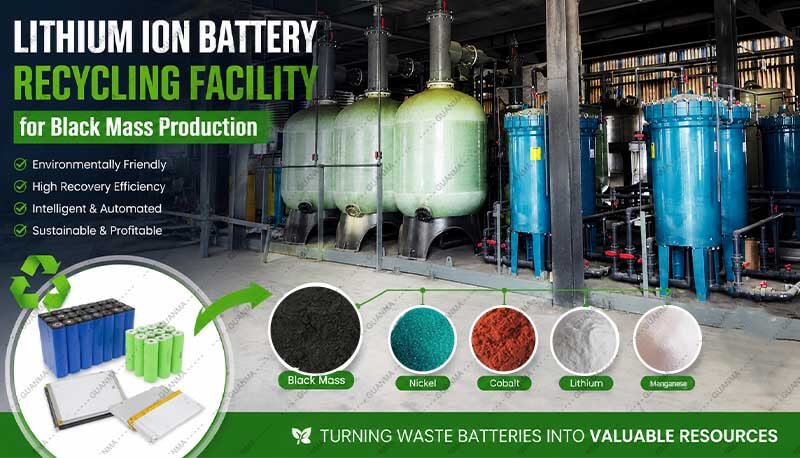
PHASE 1 — Black Mass Production Line: Turning Spent Batteries Into High-Value Powder
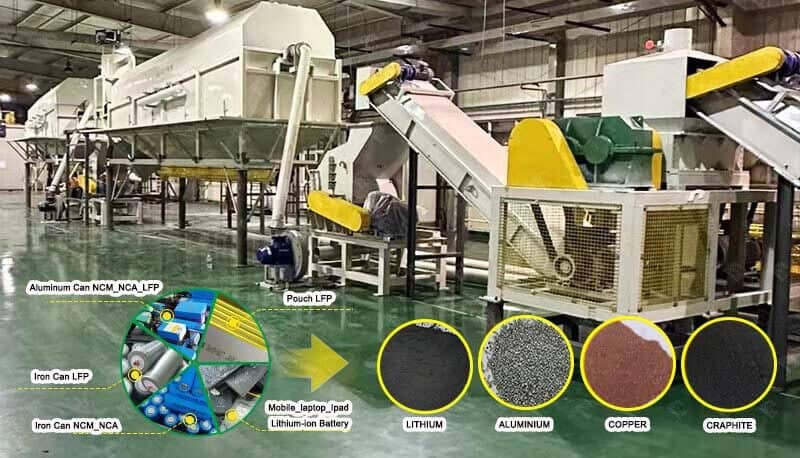
Complete mechanical lithium battery processing line for the production of black mass from end-of-life lithium-ion batteries. Black mass—the fine powder containing lithium, nickel, cobalt, and manganese. Contamination here multiplies costs in hydrometallurgy. That is why Guanma Machinery lithium battery recycling plant safely removing all undesirable fractions.
1. Safe Battery Discharge System
Our lithium battery recycling facility incorporates an automated discharge system that safely drains remaining charge from modules and cells.
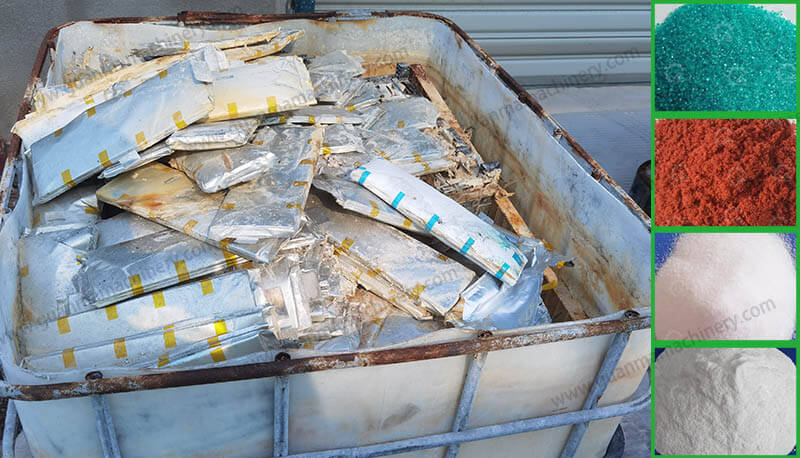
2. Shredding and Crushing Equipment
Inert atmosphere shredding is the heart of any safe lithium battery recycling facility. Guanma Machinery’s primary shredder operates under nitrogen blanketing to keep oxygen levels below the combustion threshold. The multi-stage size reduction cascade breaks down battery packs, modules, and cells into small fragments.
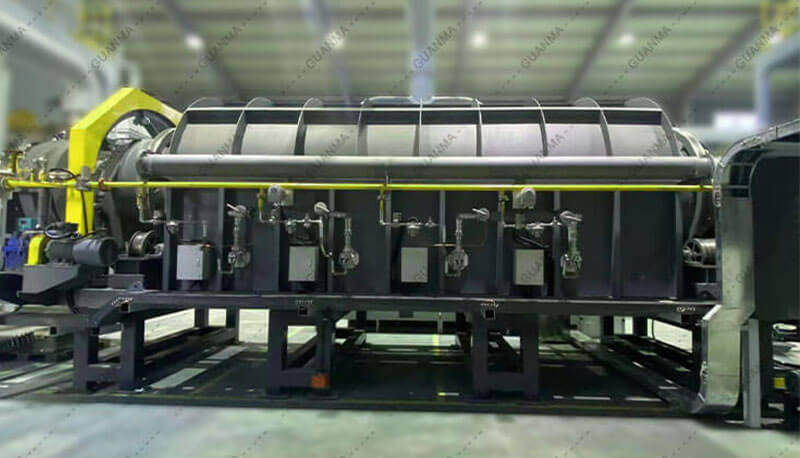
3. Thermal Pre-treatment / Pyrolysis Unit
Our dedicated battery pyrolysis furnace applies precisely controlled indirect heat in an oxygen-free environment, gently volatilizing the organic electrolyte solvents and LiPF₆ salts while decomposing the polymer binder that sticks electrode coatings to the metal foils.
4. Material Separation: Copper Foil, Aluminum Foil, Casing, and Electrolyte
After pyrolysis, the treated material passes through a sequence of sieving, air classification, and magnetic and eddy-current separation. This mechanical separation line effectively splits the stream into:
Coarse oversize: mainly copper foil pieces and aluminum foil pieces, which are further purified and sold as high-value scrap.
Steel and magnetic casing fragments: recovered by magnetic separators.
Ultra-fine fraction: the coveted black mass, containing lithium metal oxides and graphite from the anodes.
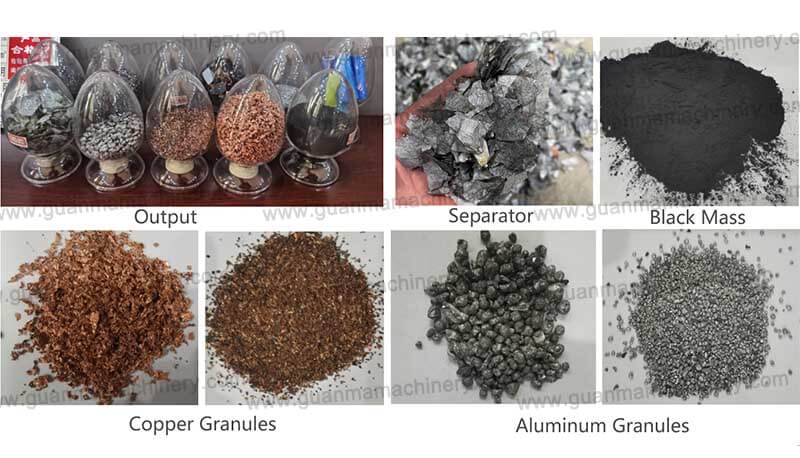
5. Black Mass Collection and Packaging
Clean black mass into the hydrometallurgical battery recycling plant or for shipment to a centralized refining hub.
6. Off-gas Treatment and Dust Collection Systems
The volatiles liberated during shredding and pyrolysis—electrolyte solvents, fluorine compounds, volatile organic compounds—are drawn into a multi-stage off-gas treatment train. Wet scrubbers polish residual fluorine, ensuring the plant’s stack emissions meet EU Industrial Emissions Directive and local environmental norms right out of the box.
7. Safety and Environmental Compliance Systems
Guanma Machinery’s black mass production facility is a closed system under continuous negative pressure. Fire detection and automatic suppression systems (inert gas) are positioned at every high-risk point—shredder, separator, and pyrolysis outlet.
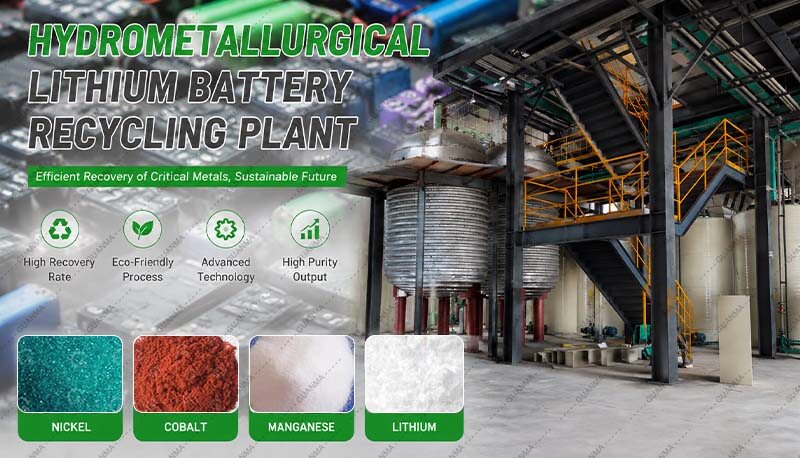
PHASE 2 — Hydrometallurgical Plant: From Black Mass to Battery-Grade Chemicals
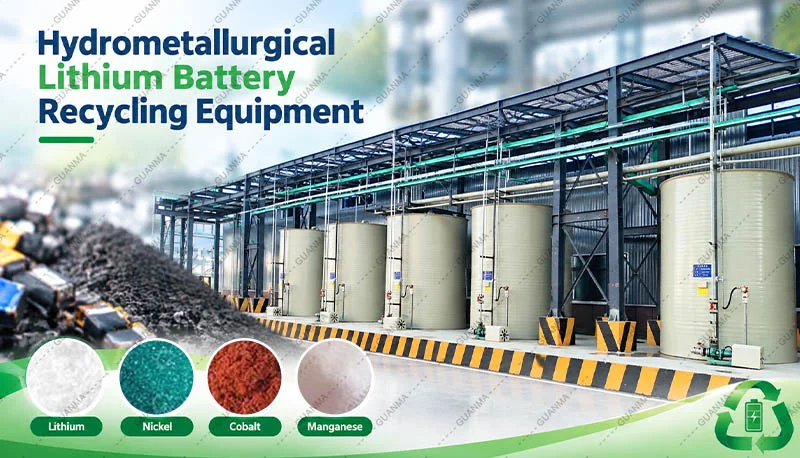
Guanma Machinery’s black mass hydrometallurgical plant refines it into battery-grade lithium carbonate, nickel sulfate, cobalt sulfate, and manganese sulfate.
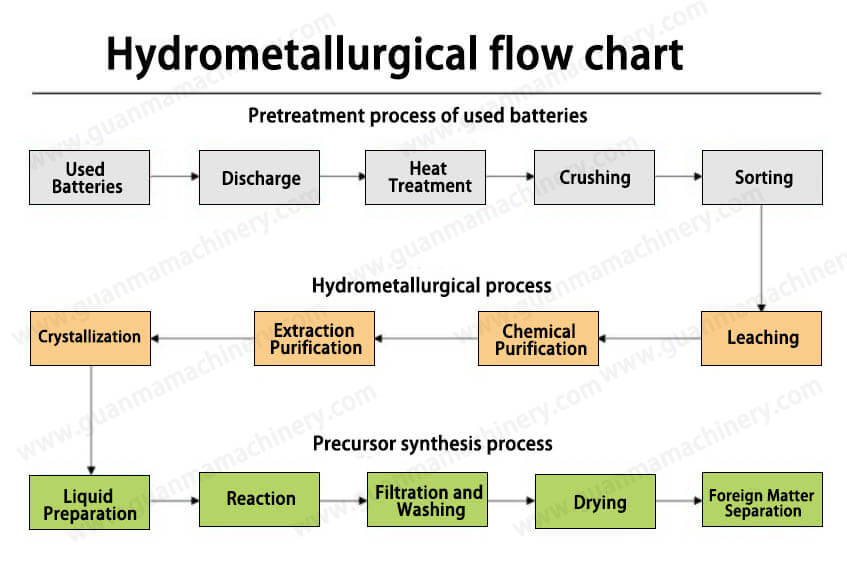
1. Leaching System
The first step in any hydrometallurgical process for lithium battery black mass is leaching. Continuous stirred-tank reactors with precise pH, temperature, and redox potential control ensure over 98% dissolution of lithium, nickel, cobalt, and manganese into solution.
2. Purification and Impurity Removal
The pregnant leach solution contains copper, iron, aluminum, and fluorine residues. Our multistage purification train uses a combination of hydrolytic precipitation, pH adjustment, and targeted chemical precipitation to drop out these impurities as easily filterable hydroxides and fluorides.
3. Solvent Extraction Units
To selectively separate nickel, cobalt, and manganese from the mixed sulfate solution, Guanma Machinery incorporates a bank of solvent extraction units. we first isolate manganese, then extract cobalt, leaving a nickel-rich raffinate.
4. Selective Precipitation for Battery-Grade Products
The strip liquors from solvent extraction and the lithium-containing raffinate each undergo crystallization or precipitation under tightly controlled conditions:
Lithium Carbonate (Li₂CO₃): The lithium stream is concentrated, purified of residual calcium and magnesium, and then reacted with sodium carbonate at elevated temperature to precipitate technical- and battery-grade lithium carbonate.
Nickel Sulfate (NiSO₄·6H₂O): The purified nickel stream is crystallized into nickel sulfate hexahydrate crystals that consistently meet battery-grade specifications for impurities such as iron, copper, zinc, and calcium.
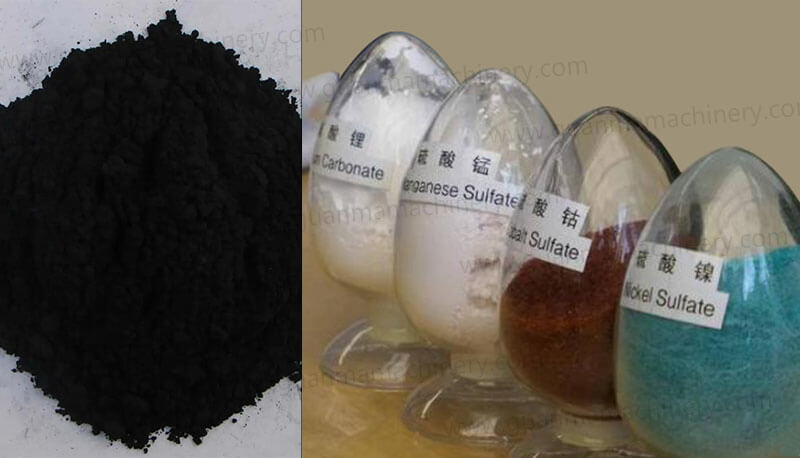
Cobalt Sulfate (CoSO₄·7H₂O): Similarly, the cobalt strip solution is converted to high-purity cobalt sulfate, a critical raw material for lithium-ion battery cathodes.
Manganese Sulfate (MnSO₄·H₂O): Manganese is recovered as battery-grade monohydrate or high-purity manganese sulfate solution, depending on client requirements.
5. Wastewater Treatment Options
A lithium battery hydrometallurgical refinery cannot succeed without robust water management. Guanma Machinery designs every facility with a dedicated wastewater treatment plant that neutralizes, clarifies, and polishes process effluents.
Explore Your Next Battery Recycling Plant with Guanma Machinery
If you are planning a lithium-ion battery recycling facility, Contact Guanma Machinery today. Tell us about your expected throughput, battery chemistries we will propose a tailored Lithium Ion Battery Recycling Facility for Black Mass Production & Hydrometallurgy that aligns with your business plan.
📩 Get Your Free Quote Today
Contact us today to discuss your project, capacity requirements, and target materials. Our team will reply within 24 hours with a customized proposal. You can also reach us directly at [email protected] — we are here to help!