If you run a lead battery recycling plant, you know the biggest challenges: low recovery rates, high energy costs, and strict environmental regulations. Traditional crushing methods often leave valuable lead in waste, hurting your bottom line and risking fines.
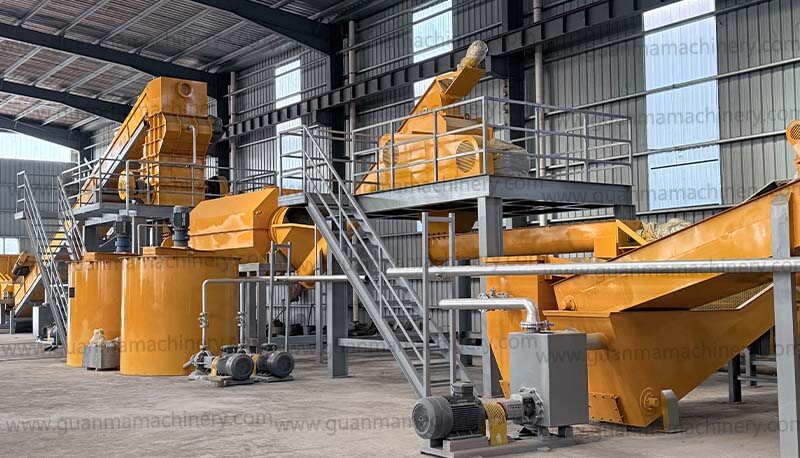
Guanma Machinery eco-friendly lead battery crushing and sorting line – engineered to deliver 99% lead recovery while minimizing dust, water pollution, and carbon footprint.
Why 99% Lead Recovery Matters to Your Business
Every 1% drop in recovery eats into your margins. On a typical 10,000-ton annual input, losing 1% of lead means 100 tons of valuable metal going to landfill – that’s tens of thousands of dollars lost.
The Challenge of Scrap Battery Recycling
When operators use outdated scrap battery breaking machines or manual labor, they encounter several pain points:
- Low Yields: Inefficient sorting leaves profitable lead paste mixed with plastic waste.
- Environmental Fines: Improper acid handling leads to soil and water contamination.
- High Labor Costs: Manual dismantling is slow, dangerous, and requires a large workforce.
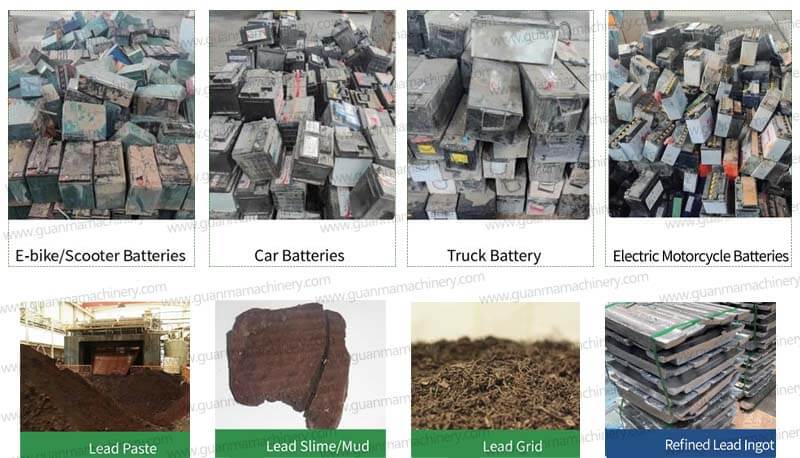
Lead Acid Battery Recycling Line
Our eco-friendly lead battery crushing and sorting line achieves 99% lead recovery through a multi-stage process that separates:
- Lead paste (for smelting)
- Metallic lead (grids and poles)
- Polypropylene (PP) plastic (reusable for battery cases)
- EBM (engineering battery material) and separators
How the Eco-Friendly Lead Battery Crushing and Sorting Line Works
We designed every component to solve real workshop problems – no complicated manuals, no daily breakdowns.
1. Automated Breaking and Crushing
Scrap batteries are fed into a water-sprayed hammer mill, which crushes them into small fragments.
2. Acid Collection and Neutralization
As the batteries are crushed, the internal sulfuric acid is washed out. The acid is then pumped into a neutralization system, transforming it into harmless water and reusable sodium sulfate.
3. Hydrodynamic Sorting (Water Separation)
The crushed mixture of plastic, heavy lead grids, and lead paste enters a hydrodynamic separator.
- Lead Paste: Fine particles settle, ready for the lead smelting furnace.
- Polypropylene (Plastic): Sinks, removed by screw conveyor.
- Heavy Lead Grids: The heavy metallic lead sinks to the bottom and is transported out via a specialized screw conveyor.
4. Intelligent Control Panel
One operator monitors the entire line via touchscreen. Alerts for blockages, wear parts, or pH imbalance. No need for 24/7 onsite supervision.

Key Benefits for Your Lead Battery Recycling Plant
Complete Solution
From the initial conveyor belt to the final lead paste filter press, we provide a complete, integrated system.
Environmental Compliance
Built to meet strict global EPA and environmental compliance standards in battery recycling.
Customizable Capacity
Whether you need to process 1 ton per hour or 10 tons per hour, the line can be scaled to fit your facility’s specific volume.
All these are exactly what our line delivers. We don’t just sell a machine – we provide a complete lead acid battery recycling solution.
Ready to Upgrade to 99% Lead Recovery?
Contact Guanma Machinery to request a quote and solutions for lead-acid battery recycling plants. We’ll provide a custom layout drawing, quotation.
Frequently Asked Questions (From Real Customers)
1. What is the processing capacity of the battery recycling line?
We understand that every plant operates at a different scale. Our standard lines are fully customizable and typically range from 1 ton per hour to 10 tons per hour. If you have higher volume requirements, our engineering team can design a bespoke high-capacity layout tailored to your specific input.
2. What are the final separated products, and can they be sold directly?
Our system is designed for high-efficiency extraction, meaning your end products are ready for the secondary market. The line separates scrap batteries into three main, high-purity components:
- Heavy Lead Grids & Terminals: Ready to be melted down in a smelting furnace.
- Lead Paste: Filtered and pressed into low-moisture cakes, highly valued by secondary lead smelters.
- Polypropylene (PP) Plastic: The battery casings are washed and chipped, making them ready to be sold to plastic recyclers or pelletizing plants.
3. Do you provide overseas installation and operator training?
Absolutely. We send engineers to your site. They will guide the installation, conduct the initial commissioning (test runs), and provide hands-on training for your local operators to ensure they know how to run and maintain the system safely.
Recommended Reading on Lead Recycling
- What is the Cost of Lead Battery Recycling Plant
- Lead Smelting and Refining Plant in Saudi Arabia
- 15Ton/H Lead Acid Battery Recycling Plant by Guanma Machinery
- Lead Ore Smelting Process
- What is Crude Lead?
📩 Get Your Free Quote Today
Contact us today to discuss your project, capacity requirements, and target materials. Our team will reply within 24 hours with a customized proposal. You can also reach us directly at [email protected] — we are here to help!